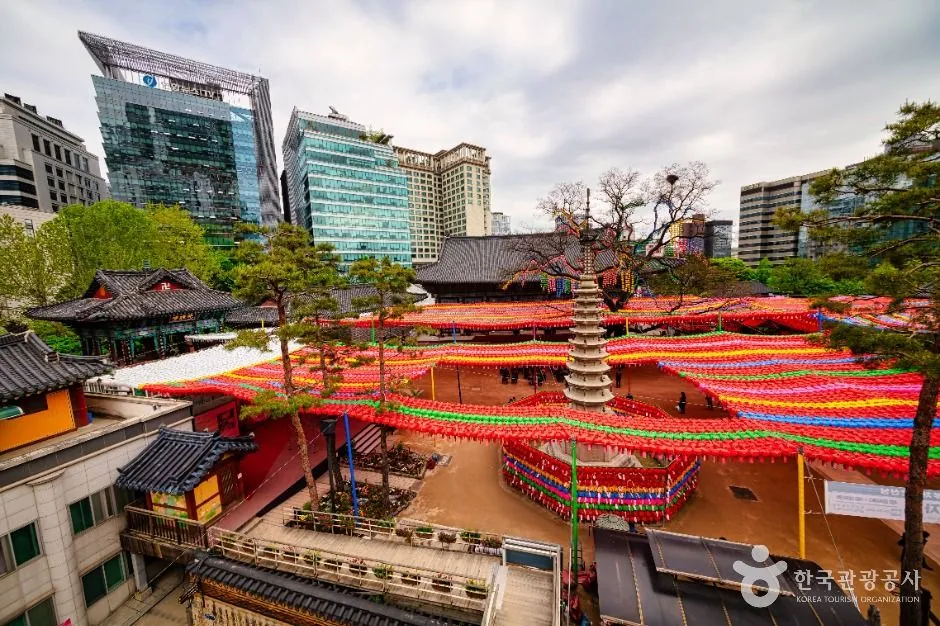
Jogyesa Temple
Wheelchair users can enter by a ramp at the main entrance, but ramps around the grounds are fairly steep and access is only partial. Jogyesa Temple is a major temple of the Jogye Order of Korean Buddhism and is free to enter. The grounds are open 24 hours.
- Wheelchair
- Partly accessibleThe main entrance has a ramp and the grounds have an accessible toilet, but ramps are fairly steep. One visitor wrote that the main hall's high threshold can be hard for wheeled mobility aids.
- Walking load
- Not rated yet
- Source
- Checked online · Oct 2026
Getting there
- Anguk StationLine 3Street elevator at Exit 6.Station
- Anguk Station toiletOutside the gates, B3, by Exit 4. Listed as not wheelchair-usable.
- Jonggak StationLine 1Street elevators at Exits 1 and 3.Station
- Jonggak Station toiletsOutside the gates, B1, by Exit 3. Wheelchair-usable.Outside the gates, B1, by Exit 1. Wheelchair-usable.
Heads-up
The Central Buddhist Museum closes on Mondays, January 1 and traditional holiday breaks. The temple grounds stay open on those days.
Hours can change with services and temple events. Call the temple before you set out.
Getting in
- Entrance
- The path and main entrance are wide with no step, and the entrance has a ramp. Part of the approach is fairly steep and can be a little hard, so take care in a wheelchair or with a stroller.
- Ramps
- There is also a wooden ramp beside stairs and an outdoor wooden ramp with handrails. The ramp beside the stairs may have a small lip or gap at its lower end, and some of its grip strips appear worn.
- Parking
- There is 1 accessible parking space, to the right of the main gate. It can be a little awkward to use, and the parking area is tight.
- Route
- Low-floor village bus Jongno 02 stops at Jogyesa. From Anguk Station Exit 6, the temple's directions use the crosswalk in front of Dongduk Gallery. It is not known whether the route from the station elevator is step-free or the crosswalk has lowered curbs.
Inside
- Paths
- The grounds have accessible pathways and ramps, but the ramps are fairly steep, so take care. One visitor wrote that the central courtyard is paved and mostly accessible.
- Main hall
- Wheelchair entry to the main hall, Daeungjeon (대웅전), is not known. One visitor wrote that its high threshold can be hard for wheeled mobility aids. Older information from 2023 describes a ramp behind the hall for viewing around it.
- Museum
- The Central Buddhist Museum is on basement level 1 of the Korean Buddhist History and Culture Center. Both have elevators, but the wheelchair route from the grounds to the museum floor is not known.
- Toilets
- An accessible toilet is behind the parking lot at the main gate. Parts of it can be awkward to use.
Also useful
- Hours
- The grounds are open 24 hours, every day, as of October 2026.
- Fees
- Entry is free and there is no ticket office, as of October 21, 2026. Parking costs 1,000 won per 10 minutes. With the discount for vehicles of people with disabilities, it is 1,000 won per hour for up to 3 hours, then 1,000 won per 10 minutes. These are the same discount coupon terms that temple members get. Ask the temple whether this covers you.
- Museum hours
- The Central Buddhist Museum is open 10:00–17:00 as of October 2026, with entry limited from 30 minutes before closing. It closes on Mondays, January 1 and traditional holiday breaks. Entry is free, but special exhibitions may charge.
- Volunteers
- The temple runs a volunteer group for people with disabilities. Ask before you visit; what help it offers is not known.
- Contact
- Call +82-2-768-8600. The temple's English website gives a separate English phone number.
Not known yet
- Is there a step-free route between the main gate, the central courtyard and the halls?
- Why is the accessible toilet awkward to use, and how much turning space does it have?
- Where are the benches and shade, and how far apart are the key spots?
- How do you request volunteer help, and is it available in English?
Sources
The summary, the notes and the lists on this page draw on these sources.
- Korea Tourism OrganizationOct 2026
- VISIT SEOULSep 2026
- Jogyesa Temple
- Central Buddhist Museum
- Yeohaeng Jeongbo SinmunMay 2023
- Go FartherDec 2025
- Seoul DanurimOct 2026
Something wrong or missing here? Tell us what you saw.
Tell usSomething wrong or missing here? Email us what you saw: hello@accessible-korea.com