Seoul Olympic Museum of Arts
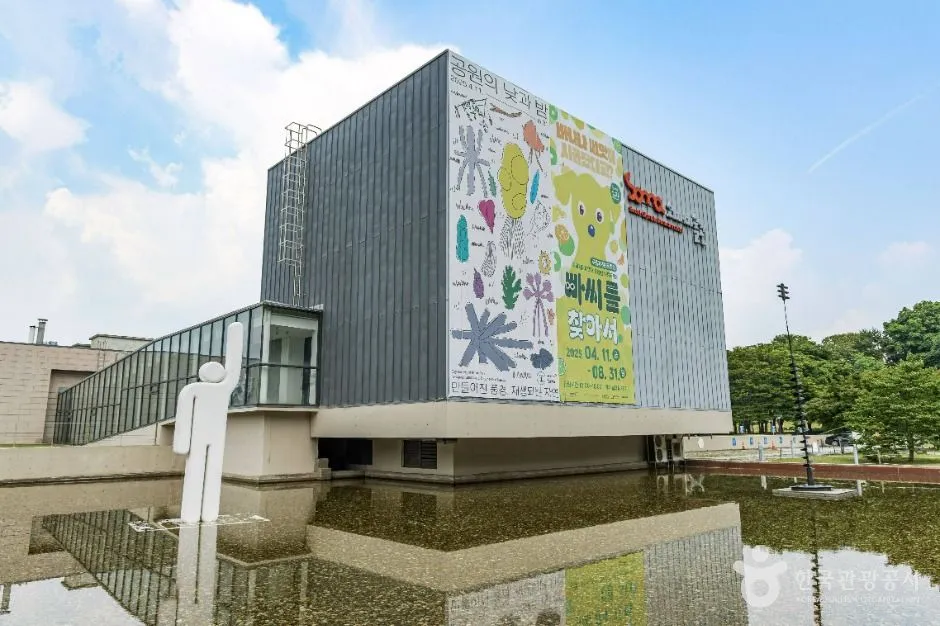
Yes, wheelchair users can visit: the museum has an entrance ramp, an elevator, and an accessible toilet. The Seoul Olympic Museum of Arts (소마미술관), or SOMA, was built to mark the Seoul Olympics and stands in the sculpture park at Olympic Park.
- Wheelchair
- Wheelchair accessibleYou can enter by ramp, use an elevator and flat indoor paths, and use an accessible toilet.
- Walking load
- MediumThe long entrance ramp and Building 2's long corridor-style hall and galleries add effort, but indoor paths are flat and there is an elevator.
- Source
- Checked online · Oct 2026
Getting there
Heads-up
The museum is closed on Mondays, January 1, and on Seollal and Chuseok days, as of October 2026.
Getting in
- Entrance
- You can enter by wheelchair using a ramp. It is gentle but long, so it can be tiring, especially in a manual wheelchair. It has handrails and a call button if you need staff help.
- Parking
- Use the South Gate 3 lot (254 spaces) or South Gate 4 lot at Olympic Park. There are 6 accessible parking spaces, in above-ground parking.
- Parking cost
- As of October 2026, parking is free for stays of 10 minutes or less. The rate is 600 won per 10 minutes, up to 20,000 won a day. A paid ticket of 5,000 won or more gives you 1 hour free. Register your car at the information desk beforehand.
- Route
- From Mongchontoseong Station, the museum directs you to Exit 1. This exit has no street elevator. See Getting there for elevator exits. From Hanseong Baekje Station, the museum directs you to Exit 2, an underground link.
Inside
- Elevator
- The museum has an elevator with room for a power wheelchair, and its buttons appear to be set low. Building 1 has galleries on floors 1 and 2, and its floor plans show an elevator symbol on each floor. A notice on the glass door outside the elevator appears to say when it cannot be used, but the conditions are unclear, so ask staff.
- Paths
- Indoor paths are flat and wide, with no slopes or steps. A help button inside the building lets you call staff.
- Building 2
- Building 2 is an underground space linked to the subway. It may have stairs in several places, and a step-free way in is not known. Call the museum at 02-425-1077 (+82-2-425-1077) before you plan to visit it.
- Toilets
- The museum has at least one accessible toilet, with room for a power wheelchair. It appears to have grab bars on both sides, and one bar may fold up.
- Wheelchairs
- You can borrow a wheelchair for 3 hours at the World Peace Gate information center by leaving an ID. It has 5 wheelchairs. As of October 2026, it opens 09:00 to 19:00 from November to February and 09:00 to 20:00 from March to October. Call 02-410-1111/1600 (+82-2-410-1111/1600). You may also be able to borrow one on Building 1's first floor. Call the museum at 02-425-1077 (+82-2-425-1077) to ask.
Also useful
- Hours
- The museum is open 10:00 to 18:00 as of October 2026. Last entry is 17:00. Sources differ on the last entry time. Call the museum at 02-425-1077 (+82-2-425-1077) to ask.
- Admission
- As of October 2026, individual admission is 5,000 won for adults, 4,000 won for youth, and 3,000 won for children. Admission is charged separately for Building 1 and Building 2, and special exhibitions have separate fees.
- Free entry
- As of October 2026, free entry is offered to ages 6 and under, ages 65 and over, people with disabilities, and some other groups. It is not clear whether this applies to foreign visitors or which people with disabilities qualify. Ask at the ticket desk whether this covers you. Entry is also free on the last Wednesday of each month and the third Saturday of October. Special exhibitions are not included.
- Vision, hearing
- Each floor has a braille guide board, and the elevator buttons have braille. There are no facilities for Deaf or hard-of-hearing visitors.
Not known yet
- Where the accessible toilets are, and how many there are
- Whether you can reach Building 2 without stairs from street level, Hanseong Baekje Station, or Building 1
- The path surface and slope from Mongchontoseong Station's elevator exit to the museum ramp
- Whether a passport works as ID for wheelchair rental
- Where you can sit and rest during your visit
Sources
The summary, the notes and the lists on this page draw on these sources.
- Korea Tourism OrganizationSep 2026
- Seoul Olympic Museum of Arts
- Seoul DanurimJun 2026
- Seoul Metro
Something wrong or missing here? Tell us what you saw.
Tell usSomething wrong or missing here? Email us what you saw: hello@accessible-korea.com