Seoul Museum of Art Seosomun Main Branch
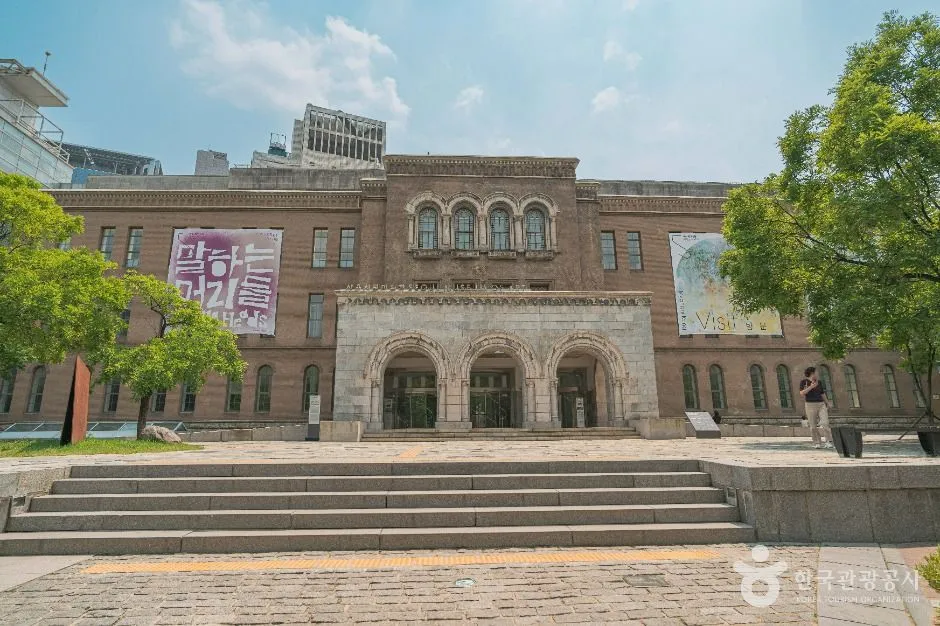
Yes, you can visit by wheelchair: the main entrance has no step, and an elevator is available. This art museum keeps the Renaissance-style front of the former Supreme Court building, with a modern building joined behind it.
- Wheelchair
- Wheelchair accessibleThe main entrance has no step, an elevator is available, you can move through the permanent exhibition rooms by wheelchair, and Floor 1 has an accessible toilet.
- Walking load
- MediumThe way in has a long, gentle ramp and an uphill walkway. Inside, an elevator and chairs on Floors 1 to 3 make the visit easier.
- Source
- Checked online · Oct 2026
Getting there
- City Hall StationLine 1 and Line 2Street elevators at Exit 9 and near Exits 1 and 2.About 160 m in a straight line.Station
- City Hall Station toiletsLine 1: Outside the gates, B1, by Exit 5. Wheelchair-usable.Line 2: Outside the gates, B2, by Exit 11. Wheelchair-usable.Line 2: Inside the gates, B1, by Exit 10. Wheelchair-usable.
- Seodaemun StationLine 5Street elevators at Exits 2 and 6.About 650 m in a straight line.Station
- Seodaemun Station toiletOutside the gates, B1, by Exits 1 and 2. Wheelchair-usable.
Heads-up
The museum is closed every Monday, but it opens if Monday is a public holiday. It is also closed on January 1, as of October 2026.
Getting in
- Entrance
- The main entrance has no step or slope, so you can go straight in by wheelchair. The door appears to be an automatic sliding glass door.
- Ramp
- The approach has steps, but a gentle ramp runs beside them. The ramp is long, and its surface may be rough stone block. The walkway along Deoksugung (덕수궁) to the museum garden runs uphill.
- Route
- The museum's directions name City Hall Station Exit 1 (Line 1) and Exit 10 (Line 2). Exit 10 has no street elevator. For elevator exits, see Getting there.
- Parking
- Two accessible parking spaces are outdoors, but the lot is tight, so use public transit if you can. Parking costs 400 won per 5 minutes on weekdays and 300 won per 5 minutes on Saturdays and public holidays, as of October 2026. Vehicles of people with disabilities get 80% off; ask at the museum whether this covers you.
Inside
- Elevator
- The maps for Floors 1, 2, and 3 show exhibition rooms and elevator symbols. From the Floor 1 entrance, go left; the elevator is on your right before the cafe. It also goes to the B1 storage room. The elevator is narrow.
- Exhibition rooms
- You can move through all of the permanent exhibition rooms by wheelchair. There are stairs in the lobby and wooden stairs from Floor 2 to Floor 3.
- Toilets
- An accessible toilet is on Floor 1, and it appears to be beside the entrance. It has an emergency call device and appears to have grab bars on both sides. Some parts may be hard to use; what they are is not known. The map legends for Floors 2 and 3 show only regular toilets.
- Seating
- Find chairs near the Floor 1 entrance and in the Floor 2 hallway. Floor 3 has chairs in the hallway, by the windows, and next to the bookshop. You can also use a folding museum chair during your visit.
- Wheelchairs
- Borrow a manual wheelchair at the Floor 1 information desk. The desk is a good height for wheelchair users.
Also useful
- Hours
- Tuesday to Thursday, the museum opens 10:00 to 20:00. Weekends and public holidays are 10:00 to 19:00 from March to October, and 10:00 to 18:00 from November to February. Friday is 10:00 to 21:00, as of October 2026. Sources differ on Friday closing time. Call 02-2124-8800 (+82-2-2124-8800) to ask before a Friday evening visit.
- Admission
- Entry is free, as of October 2026. Special exhibitions charge a fee.
- Guides
- Use the museum app for audio guides in Korean and English, sign language guides, and Korean captions. A sign language guide service runs on the first Friday of each month at 19:00, as of October 2026.
- Family toilet
- A family toilet is available. If a companion of another gender is helping an older visitor or a wheelchair user, this toilet may be useful; ask staff first.
Not known yet
- Elevator door width and inside size
- What makes parts of the accessible toilet hard to use, its door type, and its turning space
- Curbs, slopes, and crossings between City Hall Station's elevator exits and the museum ramp
- Number of wheelchairs to borrow and the conditions for foreign visitors
- Special exhibition discounts and whether foreign visitors qualify
Sources
The summary, the notes and the lists on this page draw on these sources.
- Korea Tourism OrganizationSep 2026
- Seoul Museum of ArtAug 2025
- Seoul DanurimSep 2026
- Seoul Metro
Something wrong or missing here? Tell us what you saw.
Tell usSomething wrong or missing here? Email us what you saw: hello@accessible-korea.com