National Palace Museum of Korea
Yes, you can visit the National Palace Museum of Korea (국립고궁박물관) by wheelchair: enter by ramp, ride the indoor elevator and use accessible toilets on each floor. Its permanent galleries cover Joseon kings, royal life and the Korean Empire on 3 floors.
- Wheelchair
- Wheelchair accessibleRamp entry, an indoor elevator and accessible toilets on each floor.
- Walking load
- Not rated yet
- Source
- Checked online · Oct 2026
Getting there
- Gyeongbokgung StationLine 3Street elevator at Exit 4.About 160 m in a straight line.Station
- Gyeongbokgung Station toiletInside the gates, B2, by Exit 3. Listed as not wheelchair-usable.
- Gwanghwamun StationLine 5Street elevator at Exit 1.About 600 m in a straight line.Station
- Gwanghwamun Station toiletOutside the gates, B1, by Exits 7 and 8. Wheelchair-usable.
Heads-up
Check the date if you plan a Monday visit. As of October 2026, the museum normally closes on the last Monday of each month. If that day is a public holiday, it closes the day after the holiday ends.
Getting in
- Entrance
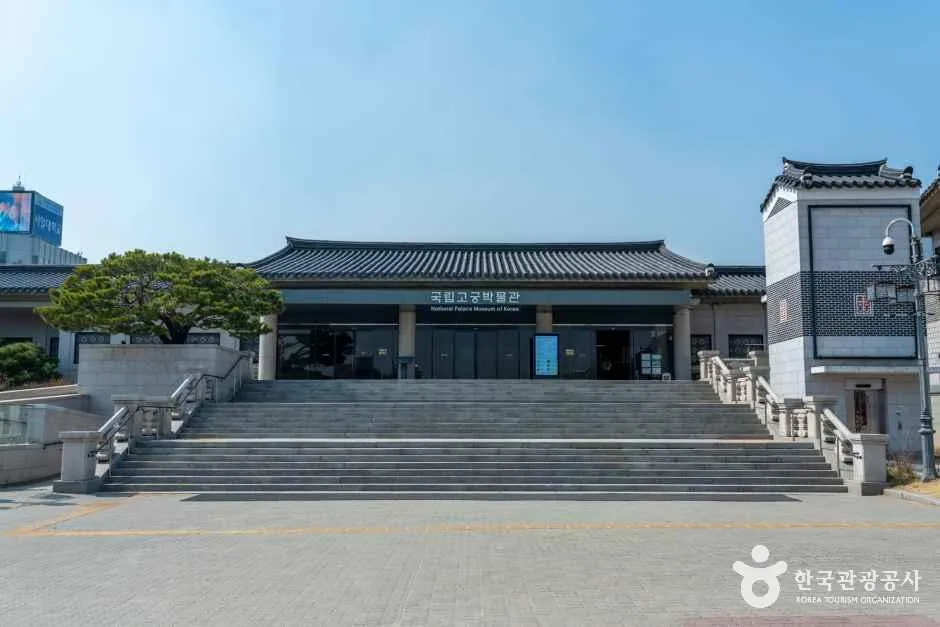
- Use the wheelchair ramps at the front entrance or at the deck entrance by Sarang Cafe. Older information from 2023 describes a gentle approach with no step, but the front door itself sits above stairs, so look for the ramp.
- Parking
- Use the Gyeongbokgung car park. The museum says it has no parking of its own. The annex car park has 2 accessible spaces, but it is not known if visitors can use them. For parking questions, call 02-736-9536 (+82-2-736-9536).
- Route
- Gyeongbokgung Exit 4 is a 4-minute walk, and Gwanghwamun Exit 1 is a 10-minute walk. Both have street elevators. Gyeongbokgung Exit 5 is a 2-minute walk, but it is not among the street elevator exits. In practice, use Exit 4 if you need an elevator. That route has a crosswalk.
Inside
- Elevators
- Permanent galleries are on 2F, 1F and B1. The museum has 2 elevators in total, serving 3 floors indoors and 1 floor outdoors. Older information from 2023 calls the elevator a little hard to use, for reasons not known.
- Toilets
- Accessible toilets are on all 3 floors of the exhibition building and in the annex, 7 in total. They may be shared or split by gender. Sources differ on whether they are shared. Call +82-2-3701-7500 (02-3701-7500 in Korea) or ask at the 2F information desk. Older information from 2023 describes roomy single rooms with automatic doors, but a little hard to use, for reasons not known.
- Rest areas
- Rest on 2F between the Joseon kings and royal life galleries, or in the central hall on B1.
- Wheelchairs
- Older visitors and people with disabilities can borrow a wheelchair for free at the 2F information desk. In 2025 the museum held 3 adult and 3 child wheelchairs. How many are available on the day is not known.
Also useful
- Hours
- As of October 2026: Sunday to Friday 09:30–17:30, last entry 17:00. Saturday and the last Wednesday of each month 09:30–21:00, last entry 20:30.
- Closed days
- As of October 2026, the museum closes on the last Monday of each month, New Year's Day, Lunar New Year's Day and Chuseok Day. If the last Monday is a public holiday, it closes the day after the holiday ends.
- Admission
- Admission is free as of October 2026, until the museum announces a change.
- In English
- The 2F information desk offers interpretation in English, Japanese and Chinese. Guide service in these languages runs on weekdays between 13:00 and 15:00, as of October 2026. See the monthly calendar on the museum website for times, and meet at the 2F lobby information desk.
- Guide devices
- Rent an audio guide at the 2F information desk: 1,000 won for the standard device or 3,000 won for the children's device, as of October 2026. It comes in English, Japanese, Chinese and Korean. Visitors with hearing loss can borrow a sign language video device for free. Both need ID.
- Phone
- Call +82-2-3701-7500 (02-3701-7500 in Korea). Whether phone staff speak English is not known.
Not known yet
- Slope and width of the entrance ramp, and whether the front door opens automatically
- Size and location of the indoor elevator
- Slopes, lowered curbs and any steps between the Exit 4 street elevator and the museum entrance
- Walking distance between galleries and the number of seats in rest areas
- Whether a foreign passport is accepted as ID for wheelchair and device rental
Sources
The summary, the notes and the lists on this page draw on these sources.
- Korea Tourism OrganizationSep 2026
- National Palace Museum of KoreaFeb 2026
- Seoul Metro
- Seoul DanurimFeb 2023
Something wrong or missing here? Tell us what you saw.
Tell usSomething wrong or missing here? Email us what you saw: hello@accessible-korea.com