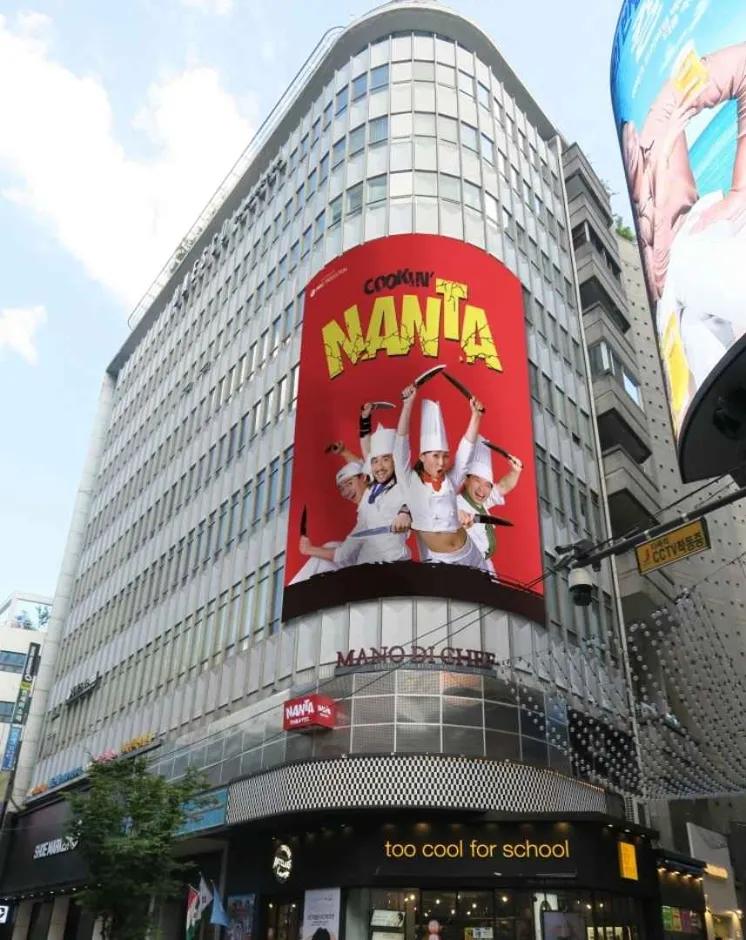
Myeongdong Nanta Theater
Wheelchair users can enter the building by the back entrance, and there is an elevator, but steps lead to the seats. Power wheelchairs and some other wheelchairs may not reach the seats. The show, Nanta, has no spoken words, so language is no barrier.
- Wheelchair
- Partly accessibleThe back entrance has no steps and there is an elevator, but a wheelchair must be carried over steps to reach the seats.
- Walking load
- Not rated yet
- Source
- Checked online · Oct 2026
Getting there
- Euljiro 1(il)-ga StationLine 2Street elevators at Exits 1 and 5.About 300 m in a straight line.Station
- Euljiro 1(il)-ga Station toiletOutside the gates, B1, by Exit 4. Wheelchair-usable.
- Myeong-dong StationLine 4Street elevator at Exit 1.About 360 m in a straight line.Station
- Myeong-dong Station toiletInside the gates, B1, by Exit 5. Listed as not wheelchair-usable.
Heads-up
Only 2 wheelchair seats exist. To use one, send a 1:1 inquiry. NANTA's inquiry email is contact-en@nanta.co.kr, and its phone number is +82-2-739-8288.
If you use a wheelchair seat, arrive at least 10 minutes before the show. Entry to these seats is limited once the show starts.
If you arrive late, follow an usher. You may be seated somewhere other than the seat you bought.
Getting in
- Entrance
- Use the back entrance of the UNESCO Building (유네스코회관), which has a ramp and no steps. Wheelchairs cannot use the main entrance.
- Parking
- The theater has no parking. Use public transit, or use a private lot near Myeongdong.
- Route
- The official walk takes 5 minutes from Euljiro 1-ga Station and 10 minutes from Myeong-dong Station. The Euljiro 1-ga route starts at stairs between Exits 5 and 6, so use an elevator exit instead.
Inside
- Elevator
- The theater is on the 3rd floor, and there is an elevator.
- Steps
- Steps lead from the lobby to the seating door, so a wheelchair must be carried over them. Sources differ on whether staff help. Email contact-en@nanta.co.kr or call +82-2-739-8288 to ask.
- Wheelchair size
- Power wheelchairs are hard to take up the steps because of their weight. Aisles are also narrow, so not every wheelchair fits; if needed, move to the theater's manual wheelchair.
- Wheelchair seats
- There are 2 wheelchair seats, A1 and A17. One travel guide says that people who can walk a short way should take a regular seat.
- Toilets
- The accessible toilet is on the 1st floor of the UNESCO Building, and the theater is on the 3rd floor. One travel guide says that the show runs about 90 minutes with no intermission, so go before it starts.
Also useful
- Hours
- As of October 2026, shows are at 5 pm and 8 pm Monday to Friday, 2 pm, 5 pm and 8 pm Saturday, and 2 pm and 5 pm Sunday and public holidays. The theater is open all year, but times can change, especially around public holidays.
- Prices
- As of October 2026, VIP seats are 70,000 won, S seats are 60,000 won and A seats are 50,000 won. One travel guide says that wheelchair seats A1 and A17 are S seats, and companions should book S seats in row A.
- Discounts
- Foreign visitors get no senior discount. As of October 2026, the disability discount starts at 25,000 won and needs a welfare card, with a 1-companion condition; without proof, you pay the difference. Ask at the ticket desk whether this covers you.
- Booking
- Online sales close 2 hours before the show, and free cancellation ends 24 hours before. You can pick up or buy tickets at the theater from 1 hour before; bring your booking number or ID.
- Wheelchair loan
- The information desk lends out 1 wheelchair.
- Children
- Children must be at least 12 months old. From 12 to 35 months they sit on a guardian's lap, and from 36 months they need a ticket.
Not known yet
- Does the back entrance open on weekends and public holidays?
- How steep is the back entrance ramp, and what kind of door does it have?
- How many steps lead to the seating door?
- How large is the 1st-floor accessible toilet, and is it open during shows?
- What is the street like between the elevator exits and the back entrance?
Sources
The summary, the notes and the lists on this page draw on these sources.
Something wrong or missing here? Tell us what you saw.
Tell usSomething wrong or missing here? Email us what you saw: hello@accessible-korea.com