The Seoul subway if you use a wheelchair or can't walk far
For many wheelchair users and slow walkers, the subway is the most practical way around Seoul. In December 2025, Seoul said all 338 stations on its city lines had an elevator route from the street to the platform, with no help needed. An adult ride of up to 10 km costs 1,550 won with a transit card. [1][2]
- 867 elevators in Seoul Metro's data for Lines 1–8, at 240 stations
- 265 of 302 station toilets on Lines 1–8 listed as wheelchair-usable
- 181 stations with a portable boarding plate
- 17 stations with a mobility helper phone line
One thing catches people out, so start there.
The elevator is usually at only one or two exits
Seoul's announcement means at least one route at each station. It does not mean every exit has an elevator. At Gyeongbokgung Station, the street elevator is at exit 4. At Myeong-dong, it is at exit 1. Come up at a different exit and there may be no elevator. [1][3]
So look up your exit before you set off. These are the stops most visitors need:
- GyeongbokgungLine 3: exit 4.
- AngukLine 3: exit 6.
- GwanghwamunLine 5: exit 1.
- City HallLine 1: near exits 1 and 2. Line 2: exit 9.
- Myeong-dongLine 4: exit 1.
- Euljiro 1(il)-gaLine 2: exits 1 and 5.
- Dongdaemun History & Culture ParkLine 2: exit 1. Line 4: exit 4. Line 5: no street elevator in this data.
- Hongik Univ.Line 2: exit 8.
- ItaewonLine 6: exit 2.
- SeoulLine 1: exits 2, 3, and 4. Line 4: exit 12.
- GangnamLine 2: exits 1 and 10.
- JamsilLine 2: exits 1 and 6. Line 8: exit 9.
- YeouinaruLine 5: exit 4.
- SeongsuLine 2: exits 1 and 4.
- Yeouido
No street elevator listed. For the Han River park, use Yeouinaru exit 4.
- Namyeong
No elevator, only a stair lift at exit 1.
- Korail stations
A July 2026 report said seven, including Guro and Hannam, had no elevator route.
Numbers are exits. Values split by a slash are for each line in order, and none means no street elevator in this data. 1·2 means the elevator is near or between those exits. Seoul Metro data, collected October 2026. Many rows carry a 2021 date.
This site has a page for each station in Seoul Metro's data for Lines 1 to 8, with street elevator exits and accessible toilets where the data lists them. Find your station.
Four things to plan around:
- Yeouido Station (Lines 5 and 9). The operators list no elevator to the street. Going to the Han River park? Use Yeouinaru, exit 4, instead. [3][4]
- Namyeong Station (Line 1). There is no elevator, only a stair lift at exit 1. [4]
- Seven stations run by Korail. A July 2026 report said that, as of July 24, Kwangwoon Univ., Seoksu, Gwanak, Guro, Hankuk Univ. of Foreign Studies, Namyeong, and Hannam had no elevator route. [5]
- Other stations in the data. This site's data lists no street elevator at 10 other stations, including Bomun, Gimpo Airport, and Hyochang Park. That may be a gap in the data, so check the station page and ask staff. [3]
If walking far is hard
Plan for the walking as well as the stairs. Here is what helps:
- Choose the route with the fewest transfers, even if it takes longer. Seoul's next goal is to make transfers at every station possible within 10 minutes. [6]
- Skip the morning rush. In late 2025, crowding on one busy stretch of Line 2 peaked at 8:30 to 9:00 a.m., and on one stretch of Line 8 at 8:00 to 8:30 a.m. Try a later start. [7]
- Look for the priority seats. Cars usually have priority seating for older, disabled, pregnant, or injured passengers. Markings vary, so follow the signs in the car. [8]
- Know that stations may be able to help. A 2018 Seoul city article said stations keep wheelchairs for people who need them. That is older information, but it is worth asking staff if walking gets too hard. [10]
Find your route before you leave
Naver Map is the app to start with. Its transit directions have a stair-avoiding option, added in 2025. Choose it and the route uses subway entrances with elevators, then shows where to board and transfer. The app works in English. [11]
Seoul Subway (또타지하철) is Seoul Metro's own app. Its Android listing describes routes for people with limited mobility, detours when a lift is down, live lift status, and boarding spots suited to wheelchair users. The app has English screens. Try it before you travel. The listing does not say which of these features work in English. [12][13][31]
Google Maps is not much help here. As of September 2026, it did not offer walking directions in Korea. [14]
From the street to the train
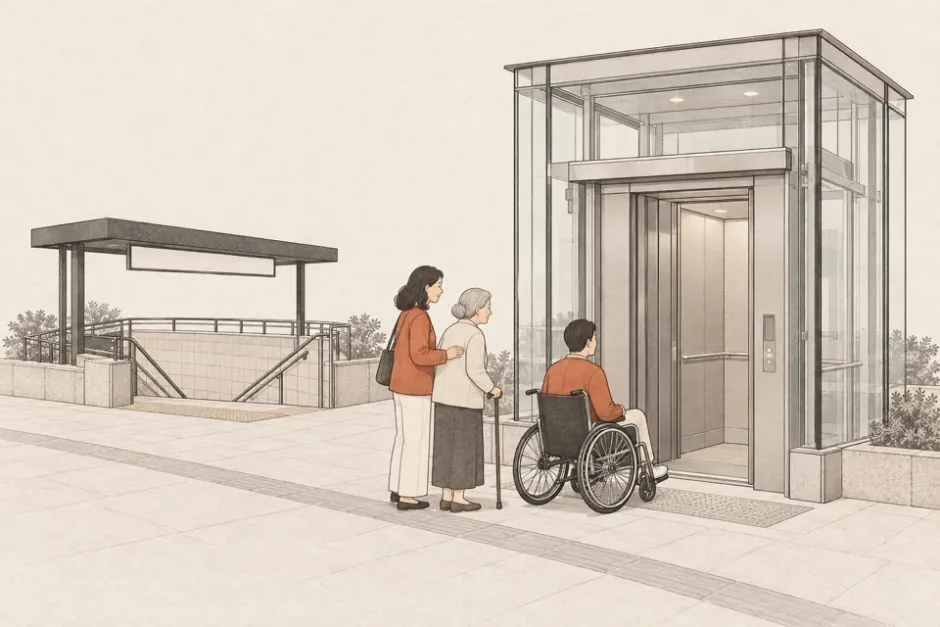
Illustration Take the right exit
Find the elevator exit you looked up. Other exits may not have an elevator.
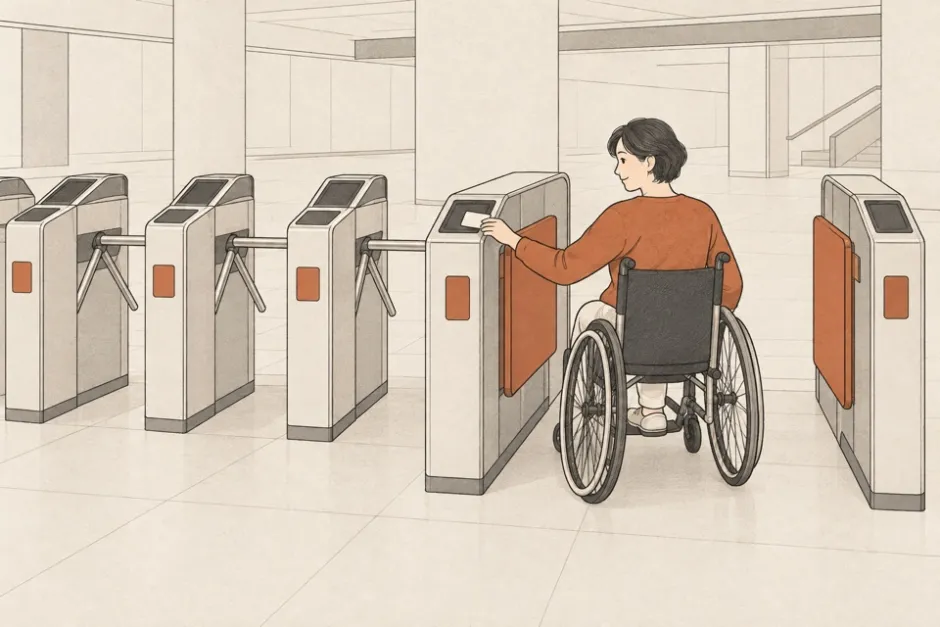
Illustration Use the wide gate
Every station must have at least one automatic gate 900 mm wide or more.
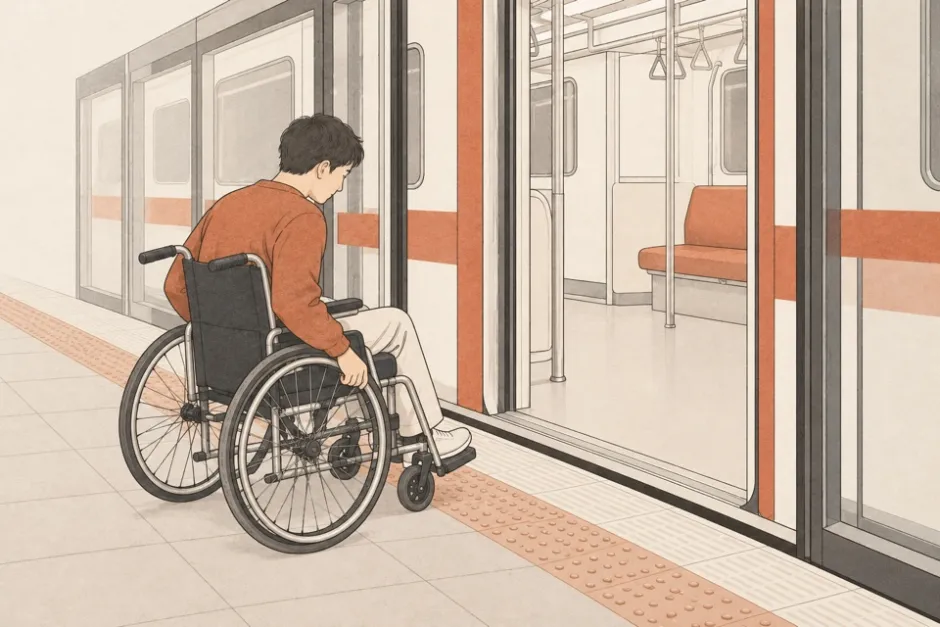
Illustration Look down at the door
In Seoul Metro's October 2024 data for Lines 1 to 8, about 81% of measured gaps were 10 cm or less. If yours looks too wide, move to another door.
Illustrations, not photos of real stations.
- Take the elevator at the right exit.
- Use the wide fare gate. Every station must have at least one automatic gate 900 mm wide or more. If a gate gives you trouble, a 2018 city article says the gate at the end has a call device for reaching staff. [15][16]
- Take the elevator down to the platform.
- Go to the wheelchair space. The next part shows where it is.
Where to wait on the platform
Wheelchair spaces are at set positions along the train, given as car and door. "4-1" means car 4, door 1.
Lines 1 to 4 · 10 cars
Lines 5 to 7 · 8 cars
Line 8 · 6 cars
From Seoul Metro's website and data file, for its own sections. On Lines 1 to 4 the last space is in car 10. Sources differ on the door, so check the platform floor. A note on the dataset page gives different doors for Lines 5 to 7, which looks like a typo. Positions can vary a little by train.
| Line | Train | Wheelchair spaces |
|---|---|---|
| Lines 1 to 4 | 10 cars | 1-4, 4-4, 7-1, and one in car 10 |
| Lines 5 to 7 | 8 cars | 1-4, 4-1, 5-4, and 8-1 |
| Line 8 | 6 cars | 1-4 and 6-1 |
These are Seoul Metro's figures for its own sections: Line 1 from Seoul Station to Cheongnyangni, the Line 2 main loop, Line 3 from Jichuk to Ogeum, Line 4 from Buramsan to Namtaeryeong, Line 5 from Banghwa to Sangil-dong and Macheon, Line 6 from Eungam to Bonghwasan, Line 7 from Jangam to Onsu, and Line 8 from Amsa History Park to Moran. Positions can vary a little by train. Check the markings on the platform floor. On Line 9, look for the space with a safety belt, opposite the priority seats. [17][18]
How wide is the gap between the platform and the train?
Usually 10 cm or less. Door-by-door figures for Seoul Metro's Lines 1 to 8, dated October 2024, show that about 69% of doors have a gap of 9 cm or less. About 81% are 10 cm or less, about 3% are over 15 cm, and only 40 of 19,240 doors are over 20 cm. [27]
Gaps vary by station. In a separate Seoul Metro dataset, most gaps rated "wide" are on curved platforms. Every door at Gangnam, Itaewon, Seongsu, Euljiro 1(il)-ga, and Yeouinaru is 10 cm or less. About half the doors at Seoul Station, Anguk, and Dongdaemun History & Culture Park are wider. Gyeongbokgung stands out: nearly every door there is wider than 10 cm, typically 14 cm and up to 18 cm. [27][28]
Go by what you see when the doors open.
- Look down when the doors open. If the gap looks fine, cross straight on, not at an angle.
- If it looks too wide, don't force it. In one 2021 report, a wheelchair got stuck in a wide gap. Move to another door and board there, even if that means waiting for the next train. [19]
- If you walk slowly or use a cane, take your time and look down as you step across.
- At Gyeongbokgung, or if no door works, ask station staff. Seoul Metro recommends a portable boarding plate for safe boarding, and its data lists plates at 181 stations. Ask at the station or call 1577-1234 (may work only from inside Korea). A 2018 city article says to ask before you board. It is worth asking whether staff can meet you with one at your stop. [10][17]
- Want to plan ahead? Seoul Metro lists the door with the smallest gap for each direction at stations with wide gaps. Going by Seoul Metro's tables, it is often not the wheelchair space door, so you may have to choose. The Seoul Subway app's listing also describes gap information. [12][17]
Asking for help without Korean
At 11 stations, you and the staff can talk through a two-way translation screen. They are Jongno 5(o)-ga, City Hall, Hongik Univ., Euljiro 1(il)-ga, Gangnam, Gyeongbokgung, Myeong-dong, Gwanghwamun, Gimpo Airport, Itaewon, and Gongdeok. [20]
Elsewhere, go to the station office and show staff a translation on your phone.
Seoul's English subway page lists two numbers for questions: 1330 (+82-2-1330 from abroad) and 02-120 (+82-2-731-2120). 1330 is the Korea Tourism Organization's travel helpline, with tourist interpretation. 02-120 is Seoul's city helpline. For English, press 9, then 1, on weekdays from 09:00 to 18:00. It offers three-way interpretation when needed. Neither says it will arrange staff or a boarding plate for you. Seoul Metro's boarding plate guide lists 1577-1234 but does not say whether English help is available. So when you can, ask in person. [17][21][29][30]
If an elevator is out of service
Check before you leave. The Seoul Subway app's listing describes live lift status, and Seoul Metro's status page lists lifts under repair at its stations on Lines 1 to 8. That page is in Korean, but the exit numbers are easy to read. [12][22]
If you find one stopped when you get there, ask staff about the station's other elevators or lifts. If there is no way up, the next station may be the easier choice.
Paying for the ride
- T-money card. Buy one at a convenience store or subway station, and add money to it. The adult fare is 1,550 won for a ride up to 10 km. [2][24]
- Climate Card for visitors. It covers the subway in Seoul and Seoul-licensed city buses for 5,000 won a day, or 20,000 won for 7 days. It does not work on the Sinbundang Line or for trips that end outside Seoul. You can get off at Incheon Airport with it, but you can't board there. [23][24]
- If you are 65 or older, plan to pay. Free-ride cards for people aged 65 or older are issued through local community centers and Shinhan Bank, so visitors should expect to pay. [9]
Finding a toilet
Accessible toilets can be inside or outside the fare gates. Station pages show which when the data says. If you have to go out through the gates, a re-entry rule can waive the basic fare when you come back. Use the same station, the same line, and the same transit card, within 15 minutes. It works once per trip, not on every line, and not with one-time tickets. [25][26]
Before you go
- Look up the elevator exit for each stop on your plan.
- Install Naver Map and try its stair-avoiding option at home.
- Install the Seoul Subway app and check that it works in your language.
- Pick the route with the fewest transfers.
- Plan your busiest travel for after the morning rush.
- Save "Where is the elevator?" and "Can you help me board?" in your translation app.
Sources
- Seoul Metropolitan Government, press release on elevator routes at all 338 stations. https://www.seoul.go.kr/news/news_report.do?nttNo=449358. December 29, 2025; checked October 2026.
- Seoul Metro, Fare guide (운임안내). http://www.seoulmetro.co.kr/kr/page.do?menuIdx=354. Date not shown; checked October 2026.
- Seoul Metro station elevator data (교통약자이용정보 엘리베이터 현황), Seoul Open Data Plaza. https://data.seoul.go.kr/dataList/OA-22740/A/1/datasetView.do. Downloaded October 2026.
- Operators' elevator lists and Korea National Railway lift data, compared for this site. October 2026.
- Kukmin Ilbo Cookie News report on Korail stations without elevator routes. https://v.daum.net/v/20260727060247110. July 27, 2026; checked November 2026.
- Kyunghyang Shinmun report on the 338-station announcement. https://www.khan.co.kr/article/202512291400001/. December 29, 2025; checked October 2026.
- Korea Railroad News, report on Seoul subway crowding. https://www.korearailroad.kr/news/articleView.html?idxno=119291. March 12, 2026; checked October 2026.
- Before Korea, "Korea Subway Etiquette for Tourists". https://beforekorea.com/korea-subway-etiquette-for-tourists/. July 22, 2026; checked October 2026.
- Seoul Metro, ticket guide (승차권안내). http://www.seoulmetro.co.kr/kr/page.do?menuIdx=355. Date not shown; checked October 2026.
- Seoul Metropolitan Government, 내 손안에 서울: subway tips for people with limited mobility. https://mediahub.seoul.go.kr/archives/1194374. November 20, 2018; checked October 2026.
- Newsis, report on Naver Map's stair-avoiding option. https://www.newsis.com/view/NISX20250801_0003275016. August 1, 2025; checked October 2026.
- Google Play, Seoul Subway (또타지하철) listing. https://play.google.com/store/apps/details/?hl=ko&id=com.seoulmetro.safety_keeper. Checked October 2026.
- Herald, report on the Seoul Subway app update for foreign visitors. https://www.heraldk.com/article/2026051820412564164. May 18, 2026; checked October 2026.
- News Tomato, report on Google Maps in Korea. https://newstomato.com/readnews.aspx?no=1313940. September 16, 2026; checked October 2026.
- G.Economy, report on Seoul Metro's accessible gates. https://www.geconomy.co.kr/news/article.html?no=320695. June 1, 2026; checked October 2026.
- Seoul Metropolitan Government, 내 손안에 서울: subway gate guide. https://mediahub.seoul.go.kr/archives/1188416. October 22, 2018; checked October 2026.
- Seoul Metro, wheelchair boarding guide (휠체어 이용 승·하차 안내). http://www.seoulmetro.co.kr/kr/page.do?menuIdx=769. Date not shown; checked October 2026.
- Seoul Metro Line 9, train facilities (차량소개). https://www.metro9.co.kr/kor/sub04_06_03.do. Date not shown; checked October 2026.
- The Korea Herald, "Wheelchair woes still blight Seoul". https://koreaherald.com/view.php?ud=20210602000491. June 2, 2021; checked October 2026.
- Seoul Metro, report on AI interpretation at 11 stations. https://news.seoul.go.kr/traffic/archives/511980. March 15, 2024, confirmed in a January 2026 city article; checked October 2026.
- Seoul Metropolitan Government, Subway (English page). https://english.seoul.go.kr/policy/transportation/modes-of-transport/subway/. June 28, 2025; checked October 2026.
- Seoul Metro, lift status page (승강설비 가동현황). https://www.seoulmetro.co.kr/kr/equipmentList.do?menuIdx=367. Checked October 2026.
- Seoul Metropolitan Government, Climate Card (English page). https://english.seoul.go.kr/policy/transportation/climate-card/. Checked October 2026.
- Seoul Metropolitan Government, Public Transportation (English page). https://english.seoul.go.kr/service/movement/public-transportation/. Checked October 2026.
- Seoul Metropolitan Government, subway re-entry rule. https://news.seoul.go.kr/traffic/archives/510086. September 26, 2023; checked October 2026.
- Yonhap News, report on subway re-entry. https://www.yna.co.kr/amp/view/AKR20261016155500004. October 18, 2026; checked October 2026.
- Korea National Railway, Seoul Metro platform gap data (국가철도공단_서울교통공사_승강장이격거리). https://www.data.go.kr/data/15041805/fileData.do. Data dated October 22, 2024; downloaded October 2026.
- Seoul Metro, platform edge and curve data (서울교통공사_연단정보와 곡선구간 정보). https://data.seoul.go.kr/dataList/OA-22124/S/1/datasetView.do. Downloaded October 2026.
- Korea Tourism Organization, 1330 Travel Helpline & Complaint Center (VISITKOREA). https://english.visitkorea.or.kr/svc/contents/contentsView.do?vcontsId=140632&menuSn=454. Date not shown; checked November 2026.
- 120 Dasan Call Foundation, foreign language counseling (외국어상담). https://www.120dasan.or.kr/dsnc/main/contents.do?menuNo=200020. Date not shown; checked November 2026.
- The Korea Herald, "Seoul Subway app revamped to improve access for foreign riders". https://www.koreaherald.com/article/10740920. May 19, 2026; checked November 2026.
Something wrong or missing here? Tell us what you saw.
Tell usSomething wrong or missing here? Email us what you saw: hello@accessible-korea.com